Skip to content

Jungian Analyst · IAAP
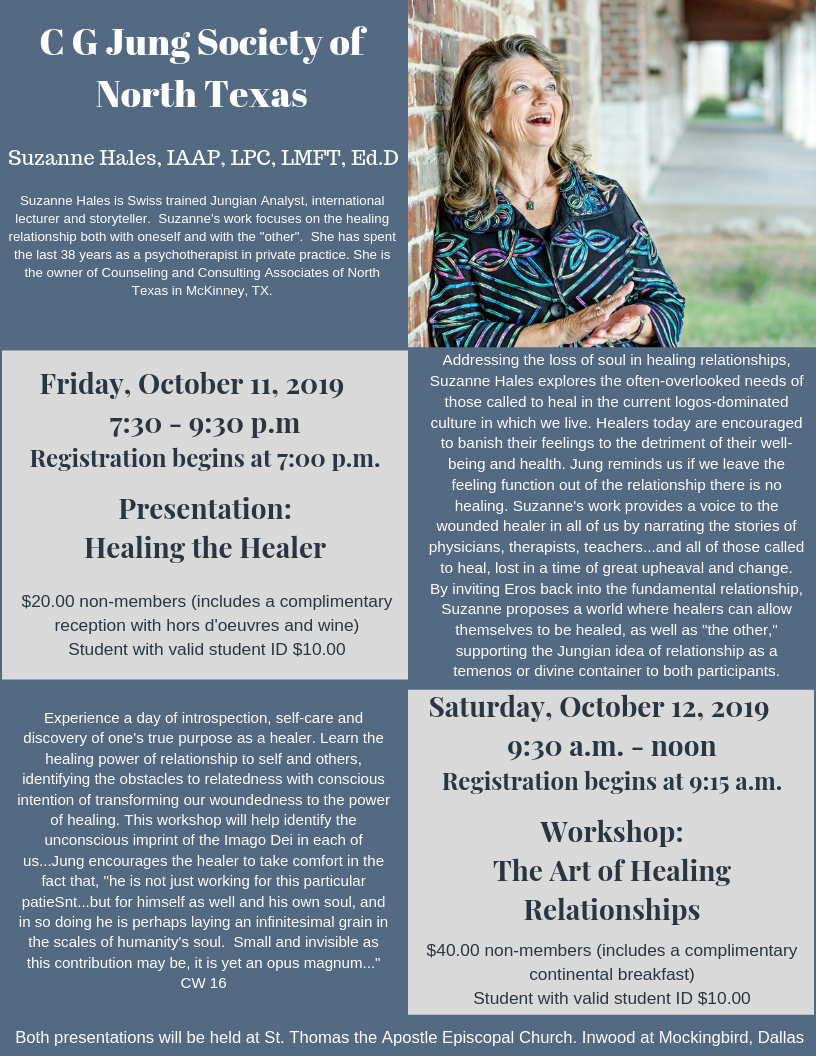
Suzanne Hales, Jungian Analyst in McKinney, TX
Ed.D., LPC-S, LMFT · Diplomate Jungian Analyst
Facilitating personal process in the tradition of Carl Jung.
- McKinney, Texas
Loneliness does not come from having no people around… but from being unable to communicate the things that seem important to oneself, or from holding certain views which others find inadmissible…
C. G. Jung
Your task is not to seek for love, but merely to seek and find all the barriers within yourself that you have built against it…
Rumi

- CCA North Texas
At a glance
Works with
Individuals, couples, families, groups & businesses
Language
English
Office
1575 Heritage Dr, Suite 200, McKinney, TX 75069
Published work
Jungian Psychotherapy with Medical Professionals
Contact our office to discuss appointments with Suzanne.
In her own words
Meet Suzanne.
I am a psychotherapist (licensed professional counselor and licensed marriage and family therapist) and Jungian Analyst in private practice in McKinney, Texas.
I teach/lecture, internationally and work with individuals, couples, families, groups, businesses as well as lead retreats at Crescent Moon Retreat Center in the Kiamichi Wilderness of Southeastern Oklahoma. I also bring the tenets of Jungian Psychology to corporations looking to create an emotionally healthy environment. I am also an internationally published author of the book Jungian Psychotherapy with Medical Professionals.
I have trained in the United States and Switzerland. The current standard of treatment in the United States focuses on Cognitive Behavioral Therapy. While CBT is certainly practical and helpful, it rarely addresses our symptoms at anything more than behavioral anomalies that can be changed with our thinking and behaviours alone, and does not take into account what the troubling symptoms might be truly saying or asking. I also have trained in Marriage and Family Systems, Archetypal and Imaginal Psychology, Sports Psychology, Gestalt and Object Relations Therapy. I am also trained as a Trauma Specialist.
I trained at the C.G. Jung Institute in Zurich Switzerland where my educational experience was steeped in the tradition of Analytical Psychology offering the avenues of therapeutic expression through art, body work, music, sandtray, dreamwork, as well as trauma of the mind and soul.
Her Approach as a Jungian Therapist in McKinney TX
A space to be seen and heard.
Jungian Psychoanalysis is a form of depth psychotherapy developed by the Swiss psychiatrist, C.G. Jung. Often for one to come to therapy and have those” hard conversations” he or she must have experienced deep suffering. Suffering is a natural part of life. However, we do not have to suffer alone, or without meaning. It is a basic human need to be seen, and to be heard. Entering into a therapeutic relationship with someone provides the time and space for that deep knowing of oneself to emerge in the presence of someone without judgment. Analysis seeks to understand the source of the suffering, delving into the unconscious patterns that we call coping skills, that have been created from our past hurts. These patterns were often developed when we were children and now as adults, many of our patterns no longer serve us, but we continue to use those old patterns because they are familiar.
The healing relationship both with oneself and the “other” is the root of psychological growth, involving introspection, self care and discovery of one’s true purpose. As humans, we seek expression of our common humanity, searching for a sense of belonging as we live in a time of vast uncertainty and challenge all around us. We are in a time of great upheaval and change. We are living in a time of crisis. Jung tells us There is no right way to wholeness as healing is made up of many detours and wrong turns as we come to learn to know and trust our deepest selves along the way.
The need for help is a deep instinctual need that dwells in each of us. A crisis of some type(even if just an internal one) is there to help us begin anew although it can be extremely painful. The experience of that emotional pain presents itself via various symptoms such as feelings of being overwhelmed, feeling trapped, shame, anxiety, depression, compulsion, addiction, relationship issues, or spiritual struggle. I see my role as analyst or therapist as someone who walks with my patients for a while, offering connection and support in finding their own inner strength and undiscovered resources, encouraging one to find wholeness, purpose and meaning to life. My desire and hope is I can offer a setting that is safe and provide a place of refuge or respite, inviting a sense of healing, as I am honored to be a witness to the unfolding of the life that sits in front of me in the consulting room. For me there is no greater honor, nor more humbling task to be experienced.
Why Jungian analysis?
One might ask why analysis? Perhaps Jung said it best” When an inner situation is not made conscious it appears outside as fate.” Many forms of therapy seek to simply relieve the symptoms one is experiencing. Analysis, while often offering symptom relief, also seeks to understand the source of such symptoms, the unconscious patterns created from wounding and trauma, and the un-lived potential in the personality that has not yet been developed.
Jungian Analysis delves below the surface of an issue and works with both conscious material and unconscious content present through work with dreams, creative process, and repeating life and relationship patterns. This discovery of what lies below the surface aids in creating deep and lasting change through increased self-awareness providing more than temporary relief of the individual symptoms.
Jungian Analysis and Analytical Psychology
Jungian analysis, also called analytical psychology, is the approach developed by Carl Jung and taught at the C.G. Jung Institutes. It works with dreams, symbols, and the patterns a person repeats without choosing them, over a longer arc than most short-term therapy. Diplomate Jungian analysts complete several years of training and personal analysis beyond their clinical licensure, which is why there are relatively few of them practising in Texas.
Avenues of therapeutic expression
Art · Body work · Music · Sandtray · Dreamwork
Several of these are offered as standalone services at CCA: art therapy and sand tray therapy.
Education & professional background
Training as a Jungian Analyst
1986
MS in Counseling Psychology
Emphasis in Marriage and Family
1998
Ed.D. in Counseling Psychology
Doctor of Education
2018
Diplomate Jungian Analyst
Analytical Psychology
Credentials & training
- Texas Education Agency Certification
- Licensed Professional Counselor
- Certified Texas Mediator
- EMDR Specialist in Trauma
- CG Jung Institute Dallas – President
- Friends of Jung Society Liaison Dallas
- Texas Counseling Association
- Licensed Marriage and Family Therapist
- Certified Imago Therapist
- Diplomate Jungian Analyst, IAAP
- CG Jung Institute Zurich
- Internationally published author :Jungian Psychotherapy with Medical Professionals
Professional affiliations
- President of CG Jung Society of Dallas
- Board and Faculty Member of ISJCC
- C G Jung Society of North Texas
Affiliations and leadership titles are listed as published on Suzanne’s existing profile.
Areas of focus
Personal process.
Purpose. Connection.
- Stories of medicine
- Relationships and couples
- Retreats, workshops and seminars
- Shame
- Grief
- Trauma
- Consulting
FAQ
Questions About Working With a Jungian Analyst
What Does a Jungian Analyst Do?
A Jungian analyst works with dreams, images, symbols and the recurring patterns in a person's life, rather than focusing only on symptoms and short-term coping. The work tends to run longer than brief therapy because it is aimed at the pattern underneath rather than the presenting problem.
How Is Jungian Analysis Different From Other Therapy?
Most talk therapy works on what you can already describe. Analytical psychology assumes a good deal of what shapes you is not yet available to describe, and works toward it through dreams, imagery and the things that repeat. Many people come to it after other approaches have helped and then plateaued.
How Many Jungian Analysts Are There in Texas?
Few. Diplomate certification through the International Association for Analytical Psychology requires years of training and personal analysis beyond clinical licensure, and most analysts train at one of a small number of institutes. Suzanne Hales trained at the C.G. Jung Institute in Zurich.
Does She Work With Organisations as Well as Individuals?
Yes. Alongside individuals, couples, families and groups, she brings Jungian principles into corporate settings and consults with businesses on workplace culture. She also leads retreats, workshops and seminars.
Has She Published Anything?
She is the author of Jungian Psychotherapy with Medical Professionals, and teaches and lectures internationally.
Is She Accepting New Clients?
Availability changes. Call 972.542.8144 and our staff will tell you her current schedule and the next opening.
Where Is Her Practice?
1575 Heritage Drive, Suite 200, McKinney, TX 75069, serving Collin County including Allen, Frisco, Plano and Prosper. Monday to Friday 8am to 7pm, Saturday by appointment.
Start a Conversation With Suzanne Hales
Our office can help you discuss appointments with Suzanne Hales.
1575 Heritage Drive, Suite 200, McKinney, TX 75069 Monday to Friday, 8am to 7pm · Saturday by appointment